Sunday, May 7, 2017

A World History Lesson for President Trump, from a Nationally Certified History Teacher.

Hello President Trump!

I’m not only a high school World History teacher, but am also one of the 320 million American citizens you represent. After seeing the interview where you said Andrew Jackson was very upset about the Civil War, despite the fact that he was dead several years before it began, I realized how necessary it is that you have at least one basic lesson in World History. The lesson I’ll present is the first lesson my students get when we start to discuss World War I, at the beginning of 4th quarter.

Everyone in Europe knows, and some Americans know, World War I was sparked when Archduke Ferdinand, of Austria-Hungary, was assassinated by Gavrilo Princip, a member of a radical, nationalist organization in Serbia. Princip shot and killed Ferdinand, heir to the throne of Austria-Hungary, and also his wife Sophie, while they were riding in the backseat of a car in a ceremonial motorcade through the streets of Sarajevo. You can picture JFK being shot in the convertible in Dallas? This was just like that, just with a much older car.

Before we go on, let me reassure you that Austria-Hungary is no longer a country, so don’t worry about reaching out to their King, or Emperor, or whatever sort of leader you think might be in charge over there.

While Ferdinand's assassination was the spark, most Europeans know, and a few Americans know, this wasn’t the cause. There were four causes of World War I, which can be easily remembered by the mnemonic (memory device) MAIN. The M stand for Militarism. The A stands for Alliances. The I stands for Imperialism. The N stands for Nationalism. Let’s look at these four causes.

Militarism: If you have a knife, but your biggest enemy has a gun, you want a bigger gun. If you have a bigger gun, your enemy wants an even bigger gun. If your enemy gets that bigger gun, you want a fully-automatic, military-grade rifle, with night-vision scope and laser sight. When you get that, he gets something that can shoot from the sky, and so on, and so on… Nations do the same thing. England had the biggest navy at the time. Remember that the sun never set on the British Empire? It takes a lot of ships to keep control over that many territories in the world, so their navy was enormous. Germany’s Kaiser Wilhelm wanted to have a navy that was larger than the two next strongest navies combined -- England and whoever was next. So Germany started building ships and submarines at break-neck pace, and when Great Britain saw Germany increasing its navy, they started building more ships, because England wanted to remain the largest navy in the world. You see how this might cause an endless escalation of arming the world’s greatest powers? Besides England and Germany, others in the area got nervous about all the naval power surrounding them, so they started ramping up military production as well. One doesn’t spend millions of Marks, Rubles, Franks, Pounds, or Dollars on weapons, with no intention of using them. I tell my students it would be like spending the entire school budget on the football team, but never having it play a game. Where you spend your money tells people where your priorities lie. Channeling that much money to your military demonstrates a readiness to deploy that military.

Alliances:
You’re familiar with NATO. Sometimes you tell us you think it’s a good thing. Other times you tell us you think it’s a bad thing. It didn’t exist prior to World War I. But there were some verbal agreements between gentlemen. The Czar of Russia, the Kaiser of Germany, and the King of England were all…. get this… first cousins! Yep. Queen Victoria was their grandmother. Yes, THAT Queen Victoria. You’re probably familiar with Victorian architecture and Victorian fashion. All of that came into vogue when Queen Victoria was in power in England. Three of her grandsons would eventually rule three of the greatest powers in the world, and they’d go to war against one another. Alliances are good when someone has your back. You know that if someone attacks you, your ally will be behind you. But alliances like this had never existed before, so when war began they created a surprising effect, like a brush fire suddenly turning into a massive conflagration across Europe. Soon countries all over the world were at war. The United States knew better than to get involved. At first. We wanted no part of such a horrible war, we didn’t cause it, and we didn’t need to enter it. But we were very happy to increase our manufacture and sales of weapons and planes. Our economy grew by leaps and bounds once the fighting began. Wars are nothing if not exceedingly profitable, for some.

But I digress. The economics of war is another issue for another class, so I won’t get into that lesson here. Long story short, the leader of Austria-Hungary was furious at the assassination of his heir, so he declared war on Serbia. Russia was an ally of Serbia, so Czar Nicholas of Russia declared war on Austria-Hungary. Germany promised to defend Austria-Hungary, so Germany's Kaiser Wilhelm declared war on his own cousin, Czar Nicholas, in Russia. King George in England entered the conflict on the side of Serbia and his cousin Czar Nicholas in Russia, also declaring war on his own first cousin, Kaiser Wilhelm in Germany, and on it went until dozens and dozens of countries all over the world were fighting.

Imperialism:
When I say that countries all over the world were fighting, I mean that every British colony around the world was fighting for Great Britain, every country colonized by the French was fighting for France, German colonies fought for Germany. You get the idea.  Additionally, there were conflicts between European nations over the borders and land claims of lands they claimed in Africa and Asia.  "If your land lies on that side of the river, and my land on this side, who controls fishing, transportation, and dumping of waste in the river?"  England controlled India, Egypt, Palestine, South Africa, Canada, Australia, Iraq,… Let’s look at what some of the other countries around the world were called at that time. There was the Belgian Congo, French Indochina, German West Africa… Africans and Asians may have had no interest in the war engulfing Europe, but since they weren’t in control their own destinies, they were dragged in.

Nationalism:
German leaders were saying things like “Germany First!” English leaders were saying, “England First!” French leaders were saying, “France First!” Nationalism, in wartime, isn’t just a celebration of one’s own culture. It’s a rejection of other cultures. If Germany is awesome, as so many Germans believed, then France and Russia and Italy and Spain must suck. If everyone feels that every other culture sucks, it’s not too hard to see everyone who is “other” as inferior, even to the point of being worthy of elimination. Nationalism can be very galvanizing, and while pride in one’s country is a fabulous thing, condescension toward other countries can be a very dangerous thing.  

Relevance:
I’m only telling you this lesson because it’s important to learn from the past, and I can’t believe all these causes of war are coming together again in such a glaringly obvious way. Here’s how you are contributing to all four factors.

Militarism: By telling the entire world that you’ll cut spending on absolutely everything, from children’s health care, to after school programs, to school lunches for impoverished children, to our world-renowned National Parks Service, to the National Endowment for the Arts, to Sesame Street – but are willing to increase spending and hiring in the military, you’re giving the rest of the world a reason to strengthen their own militaries. Guys like Kim Jong-Un can point to American military build-up and justify his own nuclear weapons testing. So can China. So can Pakistan. So can every country we make nervous right now, which somehow recently started to include Australia – a mind-boggling development if ever there was one.

Alliances:
If two boys offend and provoke each other, they’re likely to get into a fist fight at school. But if one boy has several friends behind him, the other boy probably won’t throw a punch. You may not see it this way, but most people see leaders of nations as grown-up boys who still offend and provoke each other, and sometimes want to throw punches. Having allies is a deterrent to war. When Saddam Hussein, a grown-up bully, invaded Kuwait in 1990, he had to contend with a huge coalition of countries rushing to Kuwait’s defense. Little, tiny Kuwait! The United Nations member nations sent soldiers and weapons, bombed the bejeezus out of the Iraqi military, and saw Kuwait’s sovereignty restored to them. Vulnerable countries, like Kuwait (and Israel), need strong allies, or else they’d be easily dominated. We might have the mightiest military in the world, but we still need our allies. Russia is up to no good, China never has our best interests in mind, and there are so many other countries who would "love to see those smug, arrogant, American assholes finally get what’s coming to them.” You might not like the phrase at this point, but we truly are “Stronger Together.” So let’s be nicer to our allies, ok? (Seriously. Would it have killed you to shake Angela Merkel’s hand?)

The “I” for “Imperialism” seems outdated. The era of European nations controlling most of Africa and Asia is over. We might better substitute the “I” in M-A-I-N for words like “Ignorant,” or “Incompetent,” or “Idiotic.” For example, sending a few people to South Korea to poison his half-brother out of paranoia at losing his authority is something a crazy leader like Kim Jong-un would do. Similarly, rejecting the Climate Change findings of the world’s entire scientific community, while believing the batshit crazy rantings of Alt-right media outlets, is a sign of an unhinged person. Concocting a story about being wiretapped by Obama, while dismissing all of the evidence to the contrary, is akin to Kim Jong-un’s paranoid approach to the world. But while it might be tempting to reassign the letter “I” to mean Ignorant, Ill-informed, Imbicile, I regret to inform you that it would be premature. Imperialism seems ridiculous in a 21st century context, but when Kim Jong-un tests his missiles and fires up the people of North Korea, he’s warning them of American Imperialism. When Osama bin Laden recruited his radical followers, he cited American Imperialism. Americans see ourselves as the defenders of Democracy, and as the champions of free people around the world. Other nations see us setting up military bases in Saudi Arabia in 1991, to repel Saddam Hussein from Kuwait, and then never leaving. Other nations saw us lead the international effort to demilitarize Iraq, but then after Iraq had dismantled their weapons program, the United States overthrew their leader, against the opposition of the United Nations and our closest allies, and then we helped set up an Iraqi government that would serve our own interests. When the government of Iraq fell, looters broke into museums and ran off with priceless antiquities, because our soldiers weren’t commanded to protect those things. Our soldiers were given orders to secure the oil wells, and they did that brilliantly. Why would any other nation dismantle their weapons program after seeing what happened to Iraq? America is not trusted by several countries around the world, but Mr. President, your rhetoric takes things to a new and terrifying level for everyone. You said of Iraq, “We should have kept the oil. I would have kept the oil.”  That’s what an imperialist would say. It suggests to other nations that the United States can decide whether to “keep the oil” or “let them keep it”. In no way does it convey to them that their oil is THEIR oil. Your statements raise a lot of anxiety in every nation that is less powerful economically or militarily than the United States. That would be every other nation in the world.

Nationalism: I don’t need to say much about this. “America First” isn’t very original. We’ve heard it before. Can you guess who said the following statements? “Germany First!” “Italy First!” “Russia First!” “Japan First!” If you guessed, “Those were the statements of the craziest dictators in the history of the world, and their nationalist ideas led to a loss of life and treasure at a level no one could ever have imagined,” you’d be correct. I love my country. I mean it. I LOVE the United States. It’s magnificent, and fantastic, or as you’d say, “really, really great.” I am so proud of American inventiveness, a Constitution that has been the model of all Democratic countries around the world, the American flag planted on the moon, the automobile, the telephone, the electric light bulb, the Personal Computer, the Internet, and the ideals of liberty and democracy we stand for and defend. There’s nowhere in the world I’d rather call home. But being a proud American does not require that I think Mexicans are murderers and drug dealers and rapists, or that Iraqis owe us anything, or that all Muslims hate America, or that refugees are dangerous. Being a proud American doesn't make me likely to look out on a crowd and point to someone while saying, “Look at my African-American over there!” Being a proud American doesn't lead me to use the name "Pocahontas" as an insult. My being a proud American is the opposite of those things. My being a proud American allows me to see the Mexican, and the Iraqi, and the Muslim, the African-American, the refugee, and the Native American as neighbors in a diverse and ever-interconnecting world.

I hope this little history lesson helps you make some important decisions in the years ahead, as you continue to lead the country I have been so proud to call home for my whole life. Unless it is in fact your goal that we end up in a world war (and I'm not ruling that out, considering the economic incentives that lie therein), there are some ways you should tweak your never-ending campaign rallies to avoid stirring up anti-foreign sentiment. I’d be happy to write your speeches, but I fear that you’d go off script and let “the Donald” shine through, so it would be far better If you just start seeing things the way they really are – enemies as enemies, allies as allies, scientific facts as facts, journalists as truth-seekers, and so on.

If you found this helpful, please let me know. I’ve got other lessons to share – lessons on the long-term and world-wide detriment of “trickle-down economics” in America, the incredible economic benefits for all that arise from increasing the minimum wage, the fabulous economic positives of moving to renewable energy, the history of the world’s great religions, the disastrous consequences of school privatization with public funds, and the importance of a free press in a democracy. Best wishes for the rest of your term. We’re all resting our hopes on you!!

Sincerely,


Karina Doyle – proud American

Friday, February 24, 2017

Gender vs. Genitals: The Bathroom Agenda That Wasn't

Last year, 2016, was the deadliest year for transgender Americans. Despite the horrors of record numbers of transgender people being killed, and a history of transgender people being gang raped, burned to death, tortured to death, or castrated, yesterday President Trump repealed the guidance pertaining to transgender students, put forth by President Obama last year. This guidance instructed school districts to allow transgender students to use the restroom that matches their gender identity. Conservatives refer to the liberal "bathroom agenda" as something that puts our children (daughters) at risk of being sexually assaulted in public restrooms by male sexual predators who pretend to be female. Who opposes these conservative measures? Over 200 local, state, and national organizations that actually work to protect people against sexual assault and domestic violence. Let's examine the facts to see how conservatives have targeted one of the most abused minorities in our society, while simultaneously portraying themselves as the victims.

GENDER

Let's start with a conversation about gender. I'm a high school teacher. Imagine someone asks me how many boys and girls I have in a class. I can usually answer this by simply looking at the list of names. David is a boy. Catherine is a girl. Linda is a girl. John is a boy.  Tracy and Jamie are... Oh, I'm not sure. On the first day of school my students enter the room. Here comes Jamie, wearing a form-fitting sweater, capri pants, attractive mid-height boots that match her belt, mascara, nail polish, long hair. Jamie's a girl. Here comes Tracy. Tracy is wearing a baggy hooded sweatshirt and blue jeans that sag. I can see the top of Tracy's boxer shorts. There's a bit of stubble on Tracy's face. Tracy uses the term "bro" while bumping fists with Michael, who is wearing a football jersey. In an instant I have identified the gender of every single student in my classroom, and I haven't seen anyone's genitals.

"WAIT!" say conservatives against the so-called "bathroom agenda". "How can you possibly know how many girls and boys are in your class if you haven't seen any genitals?"

GENITALS

This illustrates the most important error concerning transgender legislation. Lawmakers aren't stating that only men can enter men's restrooms. They are saying that only penises can enter men's restrooms. This might seem like the same thing, but it isn't. Not always. About 6 in every 1,000 people are transgender. That means the woman in the restroom who is re-applying her mascara in the mirror, and fussing over the chip in her nail polish -- has a penis. The man you see in the restroom, with the sleeveless t-shirt, flat chest, camouflage cap, and a beard -- has a vagina.

This is not an easy thing to comprehend. I totally understand. I was never taught that girls could have penises and boys could have vaginas. It seems completely absurd. To most people it feels as absurd as if I hold up a photo of an elephant and say "this is an elephant, but 1% of the time this could be a giraffe." It's incomprehensible. The "T" in LGBT has long been misunderstood and I'll soon explain how it has also been misrepresented. As a person who is not Transgender I do not claim to be an expert. I'm just pointing out that we already know who the women in our midst are, and if one of them walks into a men's restroom there will be a lot of discomfort from the guys at the urinals. If she pulls up her dress to reveal a penis as proof of restroom eligibility, she might be beaten to death.

SEXUAL IDENTITY vs. SEXUAL ORIENTATION

LGBT stands for Lesbian, Gay, Bisexual, and Transgender. The LGB all have to do with sexual orientation. The T has to do with sexual identity. Sex organs are the sole determinant of "Gender" on a birth certificate. If a baby enters the world with a vagina, that baby is a female. Transgender individuals identify as one gender, while possessing the genitals of the other. It must be understood that sexual identity -- "are you a boy or girl?" is not the same as sexual orientation -- "do you feel attracted more to boys or to girls?" A toddler can tell you if he's a boy. But he won't know who he is attracted to until he starts to feel an attraction -- which won't happen until his early teens.

"THE TRANSGENDER AGENDA"

I have recently read articles about how "the transgender agenda" is currently targeting the traditional binary bathroom model, but its ultimate agenda is to de-sex society. These articles claim that marriage equality efforts by gays and lesbians was one step toward this agenda, which disrupted the husband/wife relationship that is the bedrock of human society, and now we have to deal with men wanting to go into women's bathrooms. WHEN WILL IT END?! As is always the case in these articles, the people in the majority seek to make themselves out to be victims. They are outraged that their religious freedoms are being trampled by those who seek to upend God's design. When presenting one's self as a victim, the other person is automatically placed in the position of aggressor. An attacker. The step that is skipped entirely is the one where one makes a case that transgender people prey on people in bathrooms. By saying we'll be safer in the women's room if we disallow transgender women to enter them is to imply that they are abusers. They are not. There has never been any evidence to support this claim whatsoever. But people sure are afraid.

But seriously, all that lady with the penis wants to do is pee! Can you please stop inventing this crazy de-genderizing conspiracy theory and JUST. LET. HER. PEE?

THE REAL VICTIMS

Firing up fear about how transgender people are part of a conspiracy to upend the very foundation of human society has horrible consequences. Hostility toward transgender people is EXCEEDINGLY common, The danger comes not just from others, but from themselves. Half of all transgender adults report having attempted suicide at some point during their lifetimes. HALF! Sixty-four percent have been victims of sexual assault as a result of their transgender status.

Keep in mind, that's only the ones who managed to survive suicide or fatal attacks long enough to make it to the survey. It's impossible to know how many lost their lives before getting the chance to answer.

Those who live their lives as the gender they know they are, rather than the gender assigned to them on a birth certificate, face an incredibly threatening world. Read about the fatal beating of this woman, or this woman, or just read this jaw-dropping list of people in a Wikipedia page that is being constantly updated. Just Google "Transgender violence" to see that none of the violence is ever the transgender person doing the attacking.

RESTROOM VULNERABILITIES

Another absurd thing about the transgender legislation is the staged portrayal of men preying on girls in restrooms. Sexual predators do exist, in alarming numbers. They occasionally target children in restrooms. Those children are boys. It's mind-boggling that people claim our children will be safe from sexual predators if we keep all penises in the men's rooms. If we want our children safe from sexual predators, we need to focus our attentions on sexual predators, not transgender people.

NOT "THE WRONG BODY"

We've heard journalists describe transgender people as "trapped in the wrong body." This is an unfortunate portrayal, because the bodies we have are the ones God gave us. If we think that God doesn't make mistakes, then the man with a vagina is exactly as he should be. To call him "her" because "she" hasn't had "the surgery" is an act of oppression. To ask him whether or not he is going to have "the surgery" is really impertinent and offensive. If you look masculine but tell me your Joe's daughter, I will not respond this way: "Daughter? Hm. So, ...you have a vagina?" I'll just take your word for it. Who would know better than Joe's daughter if she's a female? Stop getting hung up on the body you think someone else should have, and just be nice to people. Also, don't pity the person. To portray the person as "trapped in the wrong body" is to suggest that they are a pitiable victim. Gender Dysphoria is a real and miserable condition caused mostly by the world telling transgender people they are broken. But transgender people can live very happy lives, as long as legislators and abusers aren't in the habit of attacking them.

TERMINOLOGY

If a guy tells you he's a guy, then he's a guy. Stop saying "she" or "her" about him.
If a woman tells you she's a woman, then she's a woman. Stop saying "he" or "him" about her.
If someone tells you what gender they are, accept that you may never know what genitals are between his/her legs. If a masculine person walks into a ladies' room, assume that person can read basic signage and knows that's where she belongs.

"Transvestite" is the term we all became very familiar with by watching The Rocky Horror Picture Show. Everyone in my generation can picture the "Transsexual Transvestite from Transylvania" doing "The Time Warp" in HIS fish-net stockings. This is just one more reason why we are all so confused! We watch a great movie, while throwing toilet paper and toast, and four decades later we realize we have learned all the wrong terminology. Tim Curry in drag is not one bit transgender. He's just a guy in fishnet nylons. Transvestites are men in drag, so Dr. Frank-N-Furter qualifies as a transvestite.

"Transgender" is the term to indicate one whose own sense of gender is not the same as the one in the vital statistics records.

"Transsexual" is a term going through some evolution. It used to mean someone who had surgically transitioned from one gender to the other, because "sex" refers to the genitals, while "gender" refers to the identity. But someone may take male or female hormones that change everything from vocal range to facial hair to breast development, so "the surgery" doesn't have to happen for someone to be considered "transsexual".

Don't say "tranny." It's rude.

TRANSGENDER PEOPLE I KNOW

I only know I know four transgender people personally. I say "know I know" because I went to a local showing of a documentary called "Faces and Facets of the Transgender Experience," and was shocked to see that some of the transgender people featured in the documentary were sitting near me in the theater. I never would have otherwise known they were transgender. That bearded guy leaning against the wall in a flannel shirt and jeans looks like a regular guy. He "passed," one might say. People who "pass" are those who everyone assumes has always been the gender they claim to be. They probably started the transition from one gender to another at a young age. We are all encountering transgender people all the time, and we just don't know it because they are living authentic lives and look the way they feel.

Some were forced to delay the transition, being advised by well-meaning parents, and under-informed health-care providers, that what they were stating so forcefully and consistently as children was "a phase." During puberty they went through permanent physical changes. In some cases these physical changes lead to a serious crisis of identity and an inability to "pass" without significant surgery, which is an enormous financial and emotional burden that not everyone can bear.

One thing that has surprised me as I have gotten to know some transgender people, is that many transgender women weren't super girly before transitioning. Of the four transgender women I've gotten to know personally, one had been a champion race car driver and auto mechanic, another had been a high-ranking police officer, another had been a combat soldier, and another had been a construction engineer. Another, who I've never met, was the greatest male athlete in the entire world... until she told the world she was actually Caitlyn Jenner. To one transgender friend I commented with sarcasm that I wouldn't expect transgender women to be such macho men. I would have expected pre-transitiion transgender women to be the stereotypical effeminate male with flamboyant mannerisms -- hair stylists, fashion designers,  maybe Broadway musical choreographers who employ copious use of "jazz hands". She replied, "We go through a lot to try and make our dads proud of us."

Transgender people put up with a lot. Try not to be yet another facet of what they have to endure.

If you want to know more about this (since I'm not an expert), start with PFLAG and GLSEN,

Sunday, June 12, 2016

The American Mass Shooting: A Tragedy In Three Acts. Coming soon to a city near you.

I woke up this Sunday morning thinking I'd turn on the television and finally watch the final episode of American Idol (recorded over two months ago) while folding laundry. I was standing there in my pajamas with the remote in my hand when what I saw on the television stopped me in my tracks. The worst mass shooting in U.S. history has taken place in Orlando, Florida. I've seen this tragedy a bunch of times before. SPOILER ALERT: Even though we're only briefly into this tragedy, I'm about to tell you how the rest of this tragedy always unfolds.

=====================

ACT I: Vitriol, Hatred, and Shooting

The play opens with a mentally ill person, or extremists of one religion or another, one color or another, one country or another, spouting hate against another group. The shooters voice their hatred against their intended targets, explain why everyone should hate the group they hate, and they explain how that group is ruining the fabric of America, threatening our moral fiber, corrupting our children, sent by the devil, and so on. The reason this play has been so riveting for so many decades is because the actors, costumes, perpetrators and victims change slightly from one performance to the next. It's always the same, but just different enough to engage us. Today's tragedy is set in a gay nightclub in Orlando, FL. Exactly one year ago today the tragedy was set in a black church, where a white man entered a black church and opened-fire on several people in attendance at a Bible study. The possible scene/plot/character combinations are endless: suburban high school, movie theater, office building, Jewish Community Center, Luby's Cafeteria, Muslim shooter on Caucasian victims, Caucasian shooter on African-American victims, and the list goes on.

In the next scene we see a venue full of unsuspecting people our antagonist is about to kill.

The shooter kills as many people as he can before being apprehended or killed.

This is where we become viewers of the viewers. The viewers include people all over the world who turn on a television and see the story as it unfolds. First the viewers are presented with aerial views of a crime scene. Today's tragedy gives us a glimpse of the roof of Pulse, a gay nightclub in Orlando, Florida. This aerial view has become an iconic and necessary part of every Mass Shooting tragedy, whether the viewer is looking at the roof of a high school, a movie theater, a cafeteria, and so on. During this part of the tragedy a news anchor tells viewers about a tragic BREAKING NEWS story. Once crews are at the site of the shooting she throws the story to the news reporter on the scene. The reporter can't get close to the scene because of police tape and potential for continued shooting, so they do their best to grab survivors or witnesses outside that perimeter.  Depending on the varying setting, we may see screaming teens running from a school, or bloodied movie theater patrons sitting on concrete parking bumpers in the parking lot outside the theater where their friends were killed, or a mother crying because her son's boyfriend was shot and taken to the hospital, but she hasn't seen her son yet and thinks he's dead inside the nightclub. Also in this act are panic-stricken family members coming to the scene, hoping they'll be able to find and take home their children, spouses, friends, or loved ones. When the witness or survivor being interviewed, still in complete shock, becomes redundant or says something inappropriate for live television, the anchor interrupts the on-site team and brings coverage back to the studio.

During Act I everything -- from the attack to the rescue efforts to the reporting -- is frenetic, unscripted, haphazard, confusing, disorganized, and messy.

ACT II: We Can Now Confirm

During Act II the news anchor tells us what's happening, as far as she knows, while information continues to come in. During this part of the tragedy the messiness and chaos of Act I is replaced by gradually increasing clarity and understanding. Various "experts" from around the world are linked to the broadcast via satellite, to give their thoughts about the tragedy. The anchor adeptly shifts from the on-site reporter to the satellite expert to various podiums as they appear from one hour to the next. Whether the the person on screen is the news anchor, satellite-linked expert, witness, survivor, or law enforcement press agent, they share the screen with the crawler at the bottom that keeps telling us how many victims there are, who the shooter might be, when a press conference might happen, and other updates. The person on screen might also be sharing the screen with heart-breaking photos or video of the tragedy.

Most people on screen will be interrupted if someone finally steps up to a podium. A law enforcement public relations spokesperson addresses journalists about the specifics of the current tragedy. Reporters ask questions, and authorities respond with, "I am not at liberty to disclose that information at this time." or "This is an ongoing investigation, and those details aren't entirely clear at this time." The people at the podium know their lines, and at this point so do I, because I've seen this so many times.

From the time of the shooting until the identity of the shooter is confirmed there is a great deal of speculation. Viewers want to know who did this horrible thing, and why. The satellite-linked experts will speculate, and journalists at press conferences will ask leading questions like, "Is this a hate crime?" or "Is there a tie to Islamic extremism?" The person behind the podium won't be able to confirm or deny these leading questions, so all of these possibilities become topics of discussion during the hours and potentially days before the shooter is officially identified.

The cameras keep rolling, and news broadcasters need to keep talking, so expert after so-called expert will sit in front of the camera and just guess about who did it. It's good theater. It would be very unsatisfying if the news broadcasters just said, "We don't know anything else right now, so we'll just stop talking until we learn more." Viewers would stop watching during the empty space, so the news staff keeps guessing. The early speculation is frequently incorrect, and the consequences of their misinformation can lead to entirely new tragedies. While all of this guessing is going on, the scene splits. As one expert tells news viewers that the shooter may have been Muslim, the other side of the scene shows Americans attacking an innocent Muslim-American father, and others burn a mosque as worshipers who built that mosque watch in despair.

When the President steps to his podium he will tell us how tragic it is that Americans have been gunned down today. He'll ask us to pray for the victims and survivors of the massacre, as well as for the families of those killed or injured. This address from the president is a very consistent part of the tragedy, and it changes very little from one shooting to the next. After the presidential address we again see the news anchor, who will continue to rotate between satellite-linked expert guests who address everything from the type of weapon used, the efficiency of the police and medical response to the tragedy, the progress of the investigation, the likely profile of someone who would do something like this, and all the likely causes of gun violence -- from mental illness, hate crimes, terrorism, and outdated gun laws.

As this heart-wrenching act concludes, viewers finally learn the shooter's identity. They also see photos that have been taken from the shooter's online social media accounts. We haven't gotten any further than this in today's tragedy, but if you haven't seen this tragedy often enough I'll let you know what will happen next. The podiums in Act II will keep popping up, from the leaders of the city where the tragedy has occurred, to the spokesperson at the hospital where victims are still recovering, to the police station that is HQ for all levels of law enforcement, to the leaders representing the targeted group, to the White House.

ACT III: Vigil, Empty Promises, and Lack of Closure

While Acts I and II are dramatic, engaging, riveting, emotional, and spell-binding, Act III is just defeating and unsatisfying. In Act III viewers know what we've known since Act I -- the identity and motives of the shooter. Everyone despondently says, "I just can't believe this can happen here." No matter how many times we see this tragedy, the disbelief that "it can happen here" is a constant.

It is also in Act III that the vigils take place. We see portraits and other photos of smiling, happy people, now dead, and we learn more about them. Flowers and messages are laid at the site of the shooting, as well as at the homes and apartments of those killed. We'll find out that one victim was a mom, another a dad, another just graduated from college, another a star athlete, or stage performer, or community volunteer, or nurse, and so on.

Politicians will attend funerals. So will protesters. One of the weirdest constants from tragedy to tragedy -- whether or not the victims were gay -- are the protesters who hold signs that say "GOD HATES FAGS."  These vocal protesters are the exception. Most of the haters who have consistently spewed hatred against the victim group will remain silent during Act III, because telling people the hated group is sent by Satan to tempt the righteous is not the same as actually shooting those people, so they don't feel any responsibility.

Another group that won't accept any responsibility in mass shootings is the National Rifle Association, which consistently and aggressively resists all forms of government limitations on firearms -- even fully automatic weapons with magazine clips full of dozens of armor-piercing bullets. Some politicians will urge legislation that would allow the Center for Disease Control -- the agency responsible for public health in our country -- to research gun violence. But even though gun violence is one of the leading causes of death in our country, and even though the CDC is tasked with researching and mitigating public health threats, Congress will not allow the CDC to research gun violence.

Toward the end of Act III the emergency vehicle lights have stopped flashing, yellow police tape has been cleared away, news crews have gone home, podiums have been rolled back to their conference rooms, funerals have concluded,  and flowers and candles at vigil sites have been cleaned up. Cries for gun regulation by the survivors, family members of those gunned down, as well as those who don't want this American Mass Shooting tragedy coming to any more cities, will be replaced by debates centered on "big-government" and "over-regulation." Vocal members of the NRA, in opposition to the large majority of the gun owners they claim to represent, will block all meaningful steps toward even researching, let alone fixing this public health crisis.

In the final scene of this tragedy we will see a guy reading baseless anti-[insert target victim group] propaganda online. He closes that internet window to reveal a website that sells fully automatic machine guns online.

Curtains close.

===============

As I write this blog we are still very early in the deadliest mass shooting in America's history.

In the days and hours to come we'll hear more from politicians from both sides of the aisle who want to prevent this from happening again. All of the politicians will voice their condolences to the victims and their families, and will look into cameras to say we need to take concrete steps to make sure this never happens again. We can expect one presidential hopeful to repeat his campaign promise to bar ALL Muslims from entering our country -- a country that was founded on religious freedom, and in which "Freedom Of Religion" is our First Amendment. We can expect some politicians and community leaders to condemn "big-government over-regulation" of firearms, while simultaneously pushing to extend The PATRIOT Act. We'll hear from the same politicians next year, if not before next year, after another mass shooting has taken place. The NRA will remain silent in the days to come, as their product is brought to everyone's attention after another mass shooting. But when the dust of this tragedy has settled and our legislators speak for tougher gun laws, the NRA will fan the flames of fear of tyranny, trying to convince everyone that gun laws are an obvious assault (they'll use the term assault) on their 2nd Amendment rights.

William Shakespeare wrote some of the most notable tragedies in literary history, In those tragedies Hamlet, King Lear, Romeo and Juliet, or others always end up lying dead on stage at the end of the final scene. In some of Shakespeare's tragedies there might be as many as 7 or 8 people laying dead on stage at the end of the play, and the emotion we feel at the end is sickening despair. But this is not Shakespeare. It's America. The stage of this tragedy has 50 bodies and counting. But today's tragedy isn't a play. The victims won't stand up and bow at curtain call. The feeling of sick, overwhelming despair is enormous. And the worst part is that this is only the most recent in a national tour of The American Mass Shooting, which may be coming soon to a city near you.

Tuesday, June 30, 2015

There's Nothing Wrong With The Bible

Have you ever sat down and read the Bible? Really read it? Not searching for some meaning or some devotional passage, but just pick it up and read the stories? It's incredible. It's more intriguing than any soap opera or dramatic series I’ve ever seen. It's got fantastic tales featuring heroes, villains, love, lust, betrayal, murder, and really strong faith in action. In fact, the word Action in the previous sentence should probably be spelled with a capital "A," because there's massive floods, rivers running with blood, plagues that kill thousands of people all at once, wars that consume entire regions, and sibling rivalries that end in murder (Cain/Abel) or betrayal (Joshua/Esau, Joseph/his brothers). The thread that holds the Bible together is its focus on a just God who generally gives you what you deserve in the Old Testament (Tanakh), or gives more than any of us have ever deserved in the New Testament. It spells out laws that are eternal and obvious (thou shalt not kill - Exodus 20), and also standards that are very hard for most of us to reach (when your neighbor strikes you on the left cheek, turn to him the right cheek also - Matt 5:38).


I've read the Bible in so many ways, with so many people, in so many Bible studies, in so many college courses, and in so many versions. I got to see a Chicago Field Museum exhibit about the Bible, which included a woman who was reassembling a 2000 year-old scroll from tiny, dried-up fragments of parchment. She wore a smock, white gloves and a face mask, and picked up the tiny little fragments with tweezers. I said, "Oh, WOW. I would LOVE that job." She had to know Biblical Aramaic, Biblical Hebrew, or coloquial ancient Greek well enough to be able to puzzle the fragile pieces together. I was in awe of what she must understand and know about the Bible, and I am always aware that if I spend my lifetime in the study of Biblical texts I would still have only scratched the surface of what is knowable.

So I'll make my foundational belief perfectly clear. THERE'S NOTHING WRONG WITH THE BIBLE.

What many Christians like myself find WRONG with the Bible is simply how Christians understand, or misunderstand, or intentionally manipulate and misconstrue the Bible in order to promote their own, non-Christian ideas. 
  • Is slavery good or bad? According to the Bible, it is bad, and according to the Bible, it is good.
  • Are men and women equal in the eyes of God? According to the Bible, they are equal, and according to the Bible, men are superior.
  • Should we forgive and turn the other cheek when people harm us? According to the Bible, we should forgive and turn the other cheek. But the Bible also says we should kill those who harm us... or those who preach falsehoods... or those curse us... including a son who curses his parents, and if he curses his parents he should be stoned to death where everyone can see (Leviticus 20:9).
Many Christian evangelicals, who I define as those who see the Bible as the complete and inerrant word of God, place their faith in the Bible as the divinely inspired and infallible word of God. When times of trouble come, there's probably a passage that will provide comfort. When feeling confused the most sensible thing would be to turn to the Bible for wisdom and guidance. When joyful, a rousing Psalm is always a wonderful thing to add to a celebration. Turning to the Bible is a fine thing, and as I've said, THERE'S NOTHING WRONG WITH THE BIBLE.

But when the Bible supersedes God, that's when the Bible has become the idol, and God is being ignored. To an evangelical Christian, everything God could ever say to us has already been said. His every message to us exists within the pages of the Bible. Our understanding of the universe has evolved tremendously in the past 2000 years, but if the Bible says God made the earth over the course of six days then it was undeniably made in six literal days. Period. (Nevermind that our definition of a day is the 24 hours it takes for our earth to rotate on its axis to face the sun, but the sun itself wasn't made until "day" 4.) Evolution, therefore, is impossible. 

Let's imagine, for sake of argument, that God is really, really amazing. Let's also suppose that our infant-like comprehension of the cosmos is really, really, REALLY small compared to the being that created the cosmos. In fact, to bolster my argument I'll throw in just a handful of verses from my all-time favorite chapters in the Bible, which brilliantly convey the magnitude of our limitless ignorance. God's monologue can be found at the end of the book of Job. For those of you who aren't familiar with the story, Job is the most perfectly faithful of all men on earth. Consequently, Job is a prosperous, successful, well-loved man with many children. Satan, an angel who not surprisingly plays “devil’s advocate” in this story, wants to test Job's faith in God, arguing that Job is only faithful because he is a prosperous, successful, well-loved man with many children. God agrees to Satan's challenge of Job's faith, allowing Satan to do anything to Job but kill him. I picture the two placing bets and shaking hands. In the first chapter Job faces loss after loss, which leads him to be rebuked and judged as unfaithful and unworthy by his friends. The next several dozen chapters his friends tell him that God doesn't make mistakes, and God rewards the righteous, so Job’s sins must be unbelievably huge to have caused his entire family to be crushed by the collapse of the house and Job's body covered in boils. Job insists on his unswerving righteousness, grieves his horrible losses, and questions aloud why God would allow such hardship to visit a man as faithful and righteous as he. In the final chapters of the book God rebukes Job for challenging his judgement, in some of the most beautiful and poetic of all religious scriptures I've ever read (although a section in the Bhagavad Gita is a strong contender).

Job 38:
4 “Where were you when I laid the foundation of the earth? Tell me, if you have understanding.
5 Who determined its measurements—surely you know! Or who stretched the line upon it?
6 On what were its bases sunk, or who laid its cornerstone,
7 when the morning stars sang together and all the sons of God shouted for joy?
8 “Or who shut in the sea with doors when it burst out from the womb,
9 when I made clouds its garment and thick darkness its swaddling band,
10 and prescribed limits for it and set bars and doors,
11 and said, ‘Thus far shall you come, and no farther, and here shall your proud waves be stayed’?

16 “Have you entered into the springs of the sea, or walked in the recesses of the deep?
17 Have the gates of death been revealed to you, or have you seen the gates of deep darkness?
18 Have you comprehended the expanse of the earth? Declare, if you know all this.

25 “Who has cleft a channel for the torrents of rain and a way for the thunderbolt,
26 to bring rain on a land where no man is, on the desert in which there is no man,
27 to satisfy the waste and desolate land, and to make the ground sprout with grass?

….it goes on for another few chapters. It’s really worth a read.

If the infinite and limitless God described in Job would like to come back to us today, to clarify the cosmos issue with us, now that we have a far greater understanding of the physics of planetary movement etc, the evangelical Christian's response to God is basically saying, "Hey, God, shut up. If you have something to tell me you should have inspired the guys who wrote this book for you 2,000 years ago to write it down."

Couldn’t there be more for us to hear? Isn't it possible God has more to say to us? Is it fair of us to confine the limitless wisdom of a deity that could create the miraculous cosmos to such a small number of words? From the perspective of Biblical inerrancy the answer to that question is no. God has nothing more to tell us. 

God has said 25% fewer words to us over the past 2,000 years than are contained in the books of the Harry Potter series.

This approach to Christianity is Bible worship, not God worship. It is idolatry. Using the Bible as the only possible access point to God places a book on a pedestal where God should be. It effectively tells God to stop speaking. 

In addition to the relatively small number of words in the Bible, what if those words contradict one another? Genesis 1 shows us an omnipotent and omniscient God who commands the universe into existence in six days with "Let there be light" and other impressive commands that result in the miracle of creation; while Genesis 2 shows us a God who creates the universe in a totally different order, with no specific timetable, and then goes looking for Adam and Eve in the garden and he can't even find them until they call out to him from behind some bushes. Well? Did God make the first human beings, both male and female, on day 6, by simply commanding them into existence? Or did God form the first man from a clod of clay, then all the rest of creation, and finally female as the last of his creation? Is God omniscient and omnipotent? Or does he need to walk around the garden searching for the only two people in existence?

There are SO MANY contradictions in the pages of the Bible, all the way through. I use Genesis 1 and Genesis 2 as examples because those are the very first two chapters of the Bible! If our reading of the Bible begins with large contradictions in the first two chapters, we should not expect it to be inerrant, eternal, and definitive on any, let alone every issue we will ever confront.

Throughout Christian history the Bible has been used to defend all manner of social injustice, as well as to promote all manner of social justice. In recent months we have heard many people discuss the relevance of the Bible's from both sides of the Marriage Equality debate. Some use specific verses in the Bible to prove that God is against all gay relationships. Some would use different verses in the Bible to prove that God is NOT against all gay relationships. 

The BIGGEST problem, however, is the inconsistent outrage applied to specific issues based on Biblical authority. In Mark 10: 2-9, Jesus explicitly condemns divorce. The pronouns Jesus uses make it clear that it is HIS wife and HER husband. Herman Cain uses this passage to prove that Jesus was against same-sex marriage. But for some reason there is no corresponding outrage about the issue of divorce that is explicitly condemned by the passage! 

There's also a story about a mob of men demanding that they be allowed to gang rape the two strangers in Sodom and Gomorrah who found hospitality in Lot's house. Rather than subject the strangers to gang rape by the townspeople, Lot offers his two virgin daughters to the angry mob, hoping to satisfy their violent demands without jeopardizing the two strangers to whom he had offered his hospitality. We later find out that the two strangers are actually angels, and right before Lot pushes his daughters out of the house to be gang raped, the angels blind all of the men in the mob. Whew! That was a close one! This story is put forth as a universal condemnation of sodomy (a word that comes from this very story, as the residents of Sodom are called Sodomites). In this story sodomy would be male-on-male gang rape, but for modern social purposes it has been generalized to include all male/male sex. With stories like this one there are long debates about what the words meant in their original Hebrew or Greek, in context or out of context, in this translation version vs. that one. The violent rape of two men is not the same as two men who love each other entering a long-lasting relationship, and so on. But ALL of these arguments presume that the Bible needs to support one's personal viewpoint because the Bible is the ultimate authority. The deification of the Bible is in itself a fundamental error in one's effort to open one's mind and heart to what God is trying to tell us TODAY. There are MANY Christians who do NOT view the Bible as inerrant, and are therefore not bound by the need to defend ourselves with Biblical passages. We simply ask ourselves if what we are doing is consistent with an effort to be kind, compassionate, welcoming, humble, generous, and truthful. 

So, my dear Christian friend, before you click to "like" another commercial about how redefining marriage ruins children; before you say "Amen" to another sermon that praises straight relationships as righteous while claiming falsely that gay relationships are no different than polygamy, pedophilia and bestiality; before you share another story about a woman who "ached every day for a dad" instead of being raised by two moms; before you vote for a politician who claim that last week’s SCOTUS decision was the worst day in American history,…. please know that you are helping to foster misunderstanding, fear, anger, hostility, and violence towards many wonderful people. Some of those people are Christians who sat right next to you in church for decades, and only wish to live as equals in the eyes of our government, if not their church. Please show more compassion. In short, be more Christlike. 


Wednesday, December 31, 2014

Mild Traumatic Brain Injury: The Toddler Years

In 3 1/2 weeks my brain injury turns two. Like living with any toddler, I don't sleep well, everything takes far more effort than it should, my memory isn't what it used to be, I have to turn down many social events, and I'm always exhausted.

When I wrote my first blog entry two years ago I was trying to inform everyone about why they weren't seeing me. At the time of my accident I was playing outdoor soccer during the spring and fall, and indoor soccer during the winter. I was volunteering with PFLAG, I was part of the Safe Schools Coalition, I was the Diversity Liaison for our school, I was teaching high school and writing course content, I was very involved with our then 4 year-old son, we attended church regularly, and I was always attending professional development workshops. In fact, I was on my way to a Holocaust Educators workshop on the morning of my car accident. My first blog post was my way of writing a single letter to answer the many questions I was getting from the many people who had been accustomed to seeing me. Two years later I'm writing this and wondering who will read it. I feel so disconnected. One by one all my involvement in all my activities stopped. I'm attending a brain injury support group now, and one woman put it this way: "At first your friends keep inviting you to things because you're still seen as part of the group. But little by little the invitations stop. ...and you find yourself grateful when they stop because then you can stop turning down invitations and you don't know what you're missing anymore."

It's New Year's Eve. My now 6 year-old son is at a kids' climbing gym, celebrating with noise makers, hats, snacks, lots of other kids, and walls that are literally made for climbing. Amy dropped him off, and will celebrate the last day of 2014 with her brother and sister-in law. I've been having occasional searing pain in my head today, and don't want everyone to keep quiet on my account, so I have elected to stay home tonight. (I'll be asleep well before midnight.)

I joined a Traumatic Brain Injury support group just last month. At one meeting I reported that I was surprised that when I worked with a Rubik's Cube for about an hour one evening I suddenly got a killer headache, and the next day I felt like I was nursing a severe hangover -- tired, groggy, sensitive to light and sound, and dragging myself through obligations I wished didn't exist. They looked at me with astonishment that I would attempt something so completely insane. "A RUBIK'S CUBE?!?! FOR AN ENTIRE HOUR?!" I shrugged dumbly. "I love puzzles. In the past I might pull a jigsaw puzzle out of its box at 7:00pm, and at 5:00am I'd still be working on it, surprised that all that time had passed. Why should I assume that one hour at a Rubik's cube, TWO YEARS AFTER MY INJURY, would cause such strong symptoms?"

And that is the question that continues to perplex me. How can I still be like this after two years?

It was during that same meeting that we celebrated the accomplishments of another member of the group, who had successfully sorted hundreds of record albums by genre and then alphabetized them with her boyfriend -- a major undertaking that left her very tired, but feeling proud and accomplished. She's an engineer, so alphabetizing and sorting are not typically things one would celebrate. Such is the aggravating condition known as Traumatic Brain Injury.

My expectations of myself are shifting of late. Six months after my injury I was trying to schedule comprehensive cognitive testing with a neuropsychologist. She said she wouldn't be able to get me in for a couple of months. I expressed concern that by then I would be so much better, and might not get a good baseline if we waited too long. She assured me that two months wouldn't make much difference. That confused me at the time. Now that two years have passed I get it. Eighteen months ago I was looking forward to when I'd be able to return to soccer, and go skiing, and go backpacking when Kaiden got old enough. The injury has aged me. Now my first reaction to plans for camping or vacations is that of anxiety. I've accepted that I won't play soccer again, because another blow to the head could have devastating effects which would impact all of us.

In April of 2014 I was informed that my job with Boulder Valley School District was being cut, so I found myself unemployed when the school year ended. The previous year I had gradually let go of all my extracurricular activities, and now I was out of a job as well. Despite being unemployed, which seems like it would result in dozens and dozens of hours of extra time in my week, I am just as exhausted and behind on projects as ever. I didn't write the annual Christmas letter this year. Last year at least I wrote the letter, and ordered photo greeting cards, but never got around to mailing them. With all those hours I'm not working it seems I could at least write and send Christmas greetings to our friends and family.

This inability to keep up with ordinary tasks simply reveals how much my mother was doing for us. For the first 18 months after my accident she was here every month, staying anywhere from 1 to 3 weeks. She would get Kaiden up and going in the mornings, get him to school, shop for groceries, cook our meals, clean the kitchen, do the laundry, walk the dog, wash the cars, play with Kaiden, get Kaiden to karate, read to Kaiden, get Kaiden bathed and ready for bed, and on and on. Since I lost my job my mother hasn't had to come out here, and instead of working I'm doing all the things just listed. I'm so grateful that my mom was able to lend so much assistance, which allowed me to continue working through my brain injury for 18 months.

Even though I am still taking one pill to help me sleep, another to keep my heart from racing wildly while I am sitting still, and another in the morning to help me focus, Hyperbaric Oxygen Therapy (HBOT) has been shown to be the only thing that can heal brain injuries. I have now had two courses of HBOT. The first course of HBOT consisted of 40 sessions, 80 minutes per day for 40 consecutive days, every day of the week except Sundays. Patients enter a chamber that is sealed and pressurized to 1.5x sea level pressure. Once the desired pressure is reached (about 10 minutes) the patient puts on a plastic hood into which pure oxygen is pumped for an hour. After the hour is over the hood comes off and the pressure is slowly let out (another 10 minutes). The idea is that the tiny little blood vessels in the brain are forced further into the cortex, and then filled with tissue-healing oxygen. The first course of treatments had profound improvements. I noticed my sound and light sensitivity had diminished. This meant that I could go out to restaurants, I could follow conversations, I stopped needing daily naps, I could interact with others more effectively, and I had more endurance to interact with Kaiden. In June I noticed the benefits wearing off a bit. While I spent the entire month of June with my parents in Illinois, I was unable to visit several people I had intended to see. I started needing my afternoon naps again. I was forced to go lay down because conversations and normal Doyle household family commotion were overwhelming to me.

I just finished the second course of treatments -- twenty this time -- last week. To have the headaches I've had today is bewildering. The pain is more severe than normal. I can only hope that the headaches are indicative of newly operational regions of cortex, and not signs of doing too much with my brain.

Despite what I am realizing is extensive whining in this blog post, Amy and I are continually aware of how blessed we are. Her job has sustained us, and she was given a promotion in 2014, so my unemployment status has not left us in financial crisis. She travels a lot with her job, so we are both stretched to the ends of our capacities, but while we're usually exhausted, we're getting through all this okay. Kaiden seems none the worse. We have very good health insurance, which we've been needing A LOT.

Additionally, we know that we have wonderful family. It is because of my accident that my mother has been a very supportive, consistent and wonderful presence in my life and in Kaiden's life these past two years -- something that would NOT have otherwise taken shape during our annual or bi-annual visits to Illinois. Having heard from so many who have lost their mothers, I am fully aware of the incredible value of the time we've shared since my accident. Finally, we are also aware that it could have been so much worse. I'm not sure how much of my former energy and cognitive ability will return as I continue to heal, but the accident was a doozie and I'm happy to have survived it at all, and with four working limbs and no more significant physical or cognitive ailments than I have. Life is Good, and we are blessed.

If you've made it to this point in the blog post I applaud you. Thanks for continuing to be a friend, despite my disconnectness. It's always good to hear from friends, especially through emails I can respond to when I am able, and with enough time to compose a reply that makes sense. Take care, and be well in 2015!

Saturday, February 15, 2014

Reproductive Rights, Marriage Equality, and Sochi

I'm sitting here with a jumble of thoughts about what I'm seeing in the world today, and I've decided to write a blog post that is less about convincing others about my views and more about launching a dialogue about what's happening. With the lead-up to the Olympics we have heard a lot about Vladimir Putin's Anti-Gay Propaganda laws that have made it open-season for violence against gays in Russia. I look around myself and see one state after another passing marriage equality measures that will someday spread to Colorado where I'll be allowed to marry.

The tide is turning here in the U.S., but there's plenty of resistance to it. DOMA and Prop 8 were overturned by the Supreme Court, but the vote was 5-4. In most states where marriage equality has passed there are protesters outside arguing that I am an abomination. In no state so far has marriage equality passed as a landslide -- it's always very close and the conversations are heated and passionate in both directions. When I step back from the personal implications of the situation I can see a much bigger historical picture, and it occurs to me that railing against Putin and Russians for being against gays is like getting upset about bathroom fixtures of a house when the foundation still hasn't been built. Don't get me wrong -- my right to marry isn't an unimportant thing to me, and I'm sure some of you appreciate the critical importance of functional yet aesthetically pleasing bathroom fixtures, so I am not trivializing this aspect of social evolution. But for now let's start at the foundation and look at the institution of marriage through the ages...

Things used to be so different. No one married who they wanted to, and marriage was never about love. It was an economic necessity that protected members of both sides of the family. So the parents of a boy (or sometimes a grown man representing himself) would meet with the parents of a girl and decide if the union between the two would be in everyone's best interest. Would the man be able to support his wife and children? Would the woman be able to make a good home and eventually care for the elders of her husband's family? Everyone hoped they had sons, because it was his wife who would care for the elders when they grew weak. Our early teen religious rituals like Confirmation and Bar Mitzvah are wonderful celebrations for our 13-14 year-old children. But they used to mark one's entry into adulthood. If a girl was old enough to have a period she was old enough to bear children, and at that point she was an adult. There was no dependable birth control, so from her early teens until menopause (or more likely death) the wife would probably be pregnant. Life expectancy was between 20-30 years old (which is why death was more likely than menopause). The thought of a woman leaving the home to pursue a career never entered anyone's mind because it was a physiological impossibility for most women, who were pregnant their entire adult lives. The entire culture was built upon men earning money and women caring for the home and offspring. This led to a clear distinction between the Public Sphere, where the men could exist and do business, and the private sphere, which was the realm of women.

This division between Public Sphere and Private Sphere has lasted for 10,000 years, and it had some obvious but unintentional consequences. If a man was abusive to his wife she couldn't leave, because she was completely dependent on him to provide money for food and shelter for herself and their children. A man, therefore, could be unfaithful to his wife, pursuing a relationship with the woman he actually loved, but a woman was never able to be unfaithful to her husband with the man she actually loved and who may have loved her back. ...at least not that anyone could ever know about...

We can look at a famous Bible story that reveals a lot about marriage, and it makes sense to look to the Bible because this is where so much of the argument against marriage equality comes from. Jacob fell head-over-heels in love with Rachel the first time he saw her, and immediately asked her father's permission to marry her. Rachel's father Laban agreed, but only if Jacob provided seven years of hard labor on the family property. Jacob agreed to the terms and worked 7 long years. Then he married Laban's daughter, only realizing the next day that it was Leah he had married. Rachel's older sister Leah hadn't been married in those seven years, so Laban needed to marry her off. It was an economic necessity and she was older, so Jacob got the wife he earned, but not the one he wanted. Laban told him if he still wanted to marry Rachel he could work another 7 years. So one week after marrying Leah, Jacob married Leah's sister Rachel, and then worked another 7 years after that marriage. But he never loved Leah, so it is said God comforted her by making her fertile and Rachel barren. What would it be like to live in a marriage where you knew you were reviled? What would it be like to see your husband fawning over your younger sister all the time? And what would it be like to see him giving Rachel's son Joseph far more love and attention than he showed to the other 10 sons he had (with Leah and two servants)? There are few stories in the Bible about true love, because love wasn't the point of marriage in those times. To use the Bible to defend "marriage between one man and one woman" is a farce, because modern marriage isn't the same as ancient marriage. David had dozens of wives, but he only really loved one in a "true love" kind of way. He sent Bathsheba's husband to the front lines of battle to be killed so he could then have her as his wife. David's son Solomon had hundreds of wives and hundreds of concubines. Abraham had a son Ishmael with his wife's servant Hagar so his line wouldn't die out. Judah ordered his second son to marry his deceased oldest son's widow, but later Judah had sex with her when he mistook her for a temple prostitute. (Having sex with a temple prostitute would have been completely acceptable if it weren't his daughter-in-law.)... I'll stop there, but I could go on and on because this is what marriage in the Bible really looks like.

Fast-forward several centuries... Or no... several decades... or wait... in some parts of the world it's still completely like this! Most underdeveloped countries, for example, still have arranged marriages. Russia is considered a modern country, but it's nearly twice the size of the United States with half the population, many ethnic groups spread over vast regions, and it has gone through multiple oppressive regimes before arriving at today's autocracy. This has influenced their social evolution a great deal.

Let's look at our social transformation. In 21st Century America we are slowly coming to realize that being gay isn't something that a man does behind his wife's back. It's part of who he is. But there are still many in our 21st Century American society who still see being gay as a behavior instead of as a character trait, and they consider this behavior to be an abomination. When they talk about rehabilitating the homosexual to become straight we're not even speaking the same language. How can a person stop being gay -- in the U.S. or in Russia? If it's a character trait, the way I see it, they can't. That would be like asking a white person to stop being white, or a curly-haired person to stop having curly hair. But if it's a behavior, they simply need to marry and/or have sex with someone of the opposite sex and the problem solved! In societies with arranged marriage, everyone is being forced to marry and have sex with people they don't love, while denying themselves the life they wish they could have with whom they love. In this context it is no more of a hardship for a gay person than a straight one. Everyone is equally miserable in their arranged marriages, gazing across rooms at the person they truly love but won't get to go home with. But today, in our society, we mostly agree that marriage is a choice two people make together and is borne out of love. And if you can marry the person you love, then I'd like to marry who I love as well. And more of us than ever are realizing that if I marry a man it won't make me any less of a lesbian.

What happened to create this dramatic shift in American culture? I think a LOT of things have led to this shift, but I'd guess that first it was the widespread access to effective contraception. In 1916, right here in the United States, a woman named Margaret Sanger was jailed for 30 days just for distributing information on birth control! It wasn't until 1938 that the Supreme Court reversed the Comstock Laws and allowed people to discuss and use birth control without fear of incarceration. If a couple has the ability to determine when to have children and how many to have, this doesn't lock a woman into the endless cycle of birthing children year after year. She looks outside the house and wonders what else might be possible.

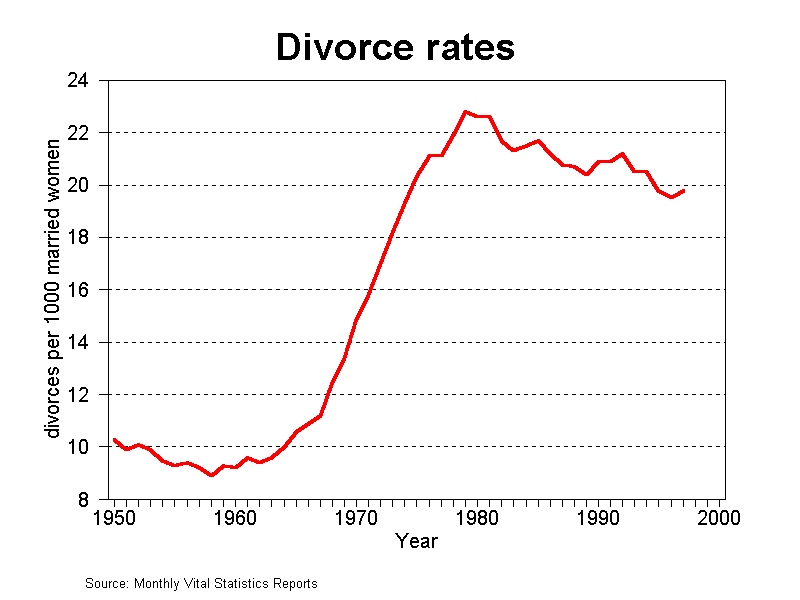
graph of divorce rates, 1950-2000
After this revolutionary shift in procreation we had a dramatic women's rights movement. During two world wars women found themselves in the workplace to earn the money to support their families and our country while the men were overseas. First they had control of their bodies, and now they experienced financial control for the first time. Not surprisingly, divorce rates increased. At that point, to an extent, women had control of their bodies, their incomes, and their relationships. They could enter into marriages when and with whom they wanted, and they could divorce husbands if the marriage wasn't working. Marriage stopped being an economic necessity. The average age of marriage rose dramatically, as people decided to wait until they were ready, and keep looking for "the one."

So if straight people can marry for love, why can't I?
From a historical perspective this is a VERY recent and radical step in this social metamorphosis.

Could we have gotten to this step without all the others that preceded it?
And where is Russia in terms of these steps?

The 20th Century saw a huge improvement in life for Americans. Two world wars overseas fueled our economy and improved our quality of life (life expectancy, availability of technology that improved health, improved infrastructure,...) without devastating our land and civilian population. Civil Rights movements illustrated the need for equality across race and gender. Widespread protests on college campuses and at political conventions led the American people to realize their power to influence legislation on Domestic and Foreign policy in this democracy.

The experience for Russia in the 20th century was the exact opposite. Russia lost more citizens in World War I and World War II than virtually all other countries combined. And that doesn't even include the Civil War that led to the rise of the Soviet Union. In fact, Russia lost more civilians than most other countries lost soldiers. Surrounding World War II Stalin's system of work camps in his Gulag incarcerated and caused the deaths of over 23 million people -- over twice the number lost in Hitler's Holocaust. Reasons for incarceration included "Marriage to a Spaniard" and other things Stalin couldn't bear. While Americans were finding their voices and power in a democracy, the people of the Soviet Union were learning that there is no use in protesting -- because those who speak up disappear, and they are probably being worked or tortured to death. What if Rosa Parks was arrested for not surrendering her seat, and then she was sent off to Alaska to be worked to death in a camp while our media painted her out to be an enemy of the state? Where would our country be in terms of racial segregation if that had been the outcome of her protest? Our country was embroiled in Civil Rights marches and Voting Rights marches at the same time as the Berlin Wall was going up. In the 1990s the post-Soviet era saw Democracy finally come to Russia under President Yeltsin, and regrettably the results were a disaster. Economic hardship hit the people hard, and the combination of Russian Mafia-type gangs and political corruption led Russia right back to the autocracy under Putin today.

Russians have a long history of learning that they are powerless against the government. As long as Russia is living in an autocracy where they aren't allowed to control much of what happens in the policies of their government, how likely is it that they will spring to defend the rights of LGBT people in their culture who are being persecuted? Will they even know if gays are being persecuted if Putin controls the media? If Putin uses the media to tell everyone that gays are pedophiles, how will the people be persuaded to fight for those they discover are gay? Why would anyone come forward in such an environment? Should we be protesting the anti-gay laws, or should we be protesting the non-Democratic culture that perpetuates it? Maybe we should fight for freedom of the press there? Should we be fighting for a woman's reproductive control and access to birth control and gainful employment? Should we be fighting for gender equality?

Shouldn't we address the foundation, walls and roof before arguing about the bathroom fixtures?